If you are searching for tree treatment near me in Buffalo NY, you are probably seeing thinning leaves, dying branches, or strange bark activity and want to know whether the tree can be saved. Western New York trees face several pests and diseases, but one dominates the conversation: emerald ash borer. This guide focuses on identification and treatment — when spraying or systemic care can help, and when removal becomes the safer choice. For the hazard side of dead ash specifically, see our companion post linked below.
Emerald ash borer Buffalo: the dominant regional threat
Emerald ash borer (EAB) has reshaped tree care across Erie County and the wider region. Adult beetles are small and metallic green, but the real damage comes from larvae tunneling under ash bark and cutting off the tree's ability to move water and nutrients. For official status, quarantine context, and homeowner guidance, use NYS DEC's official emerald ash borer resource — it is the authoritative New York source on EAB.
Once an ash is heavily infested, it can decline quickly and become structurally unreliable. That is why many homeowners eventually need removal — and why our related guide on why dead ash trees are dangerous in Buffalo NY focuses on hazard and failure risk, while this page focuses on spotting problems early enough for tree treatment services near me to matter.
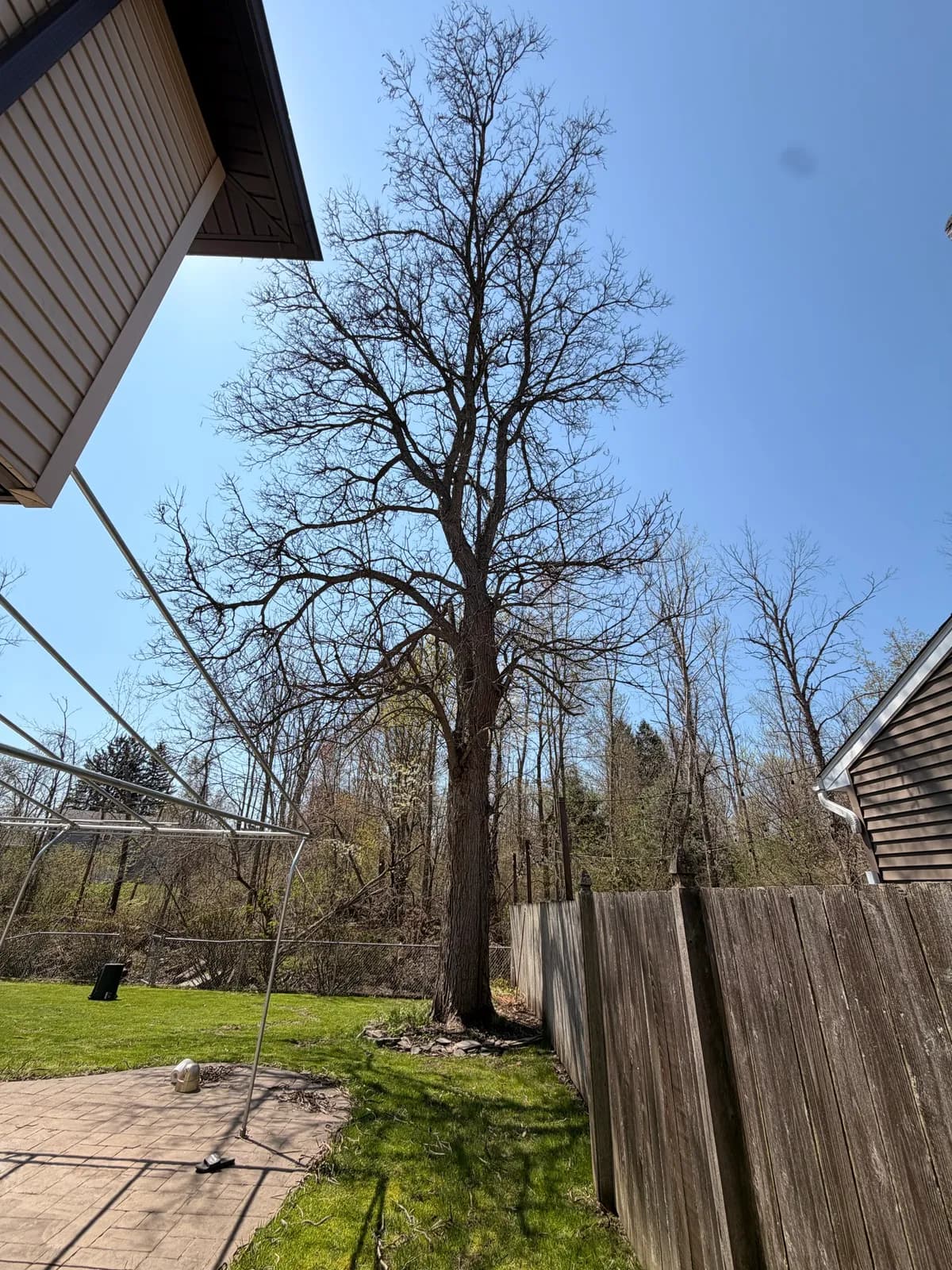
Other common pests and diseases in Western New York
EAB gets the headlines, but it is not the only issue a local tree spraying company or arborist evaluates. A few other problems show up regularly on Buffalo-area properties:
Dutch elm disease and elm decline
Elms can still suffer wilt and dieback from Dutch elm disease pathways. Early leaf yellowing on individual branches and progressive canopy loss are cues to get a diagnosis before the whole tree is written off.
Anthracnose and foliar fungal issues
Wet springs in Western New York favor leaf-spotting fungi on maples, sycamores, and other hardwoods. These issues are often more cosmetic than lethal, but severe repeat infections can stress trees already dealing with poor sites or drought.
Root collar and basal decay
Not every decline is an insect. Compacted soil, grade changes, lawn damage at the trunk flare, and fungal decay at the base can thin a canopy and raise failure risk. Treatment here may mean cultural care and monitoring — or removal if structure is compromised.
How to spot early signs before the tree is a write-off
- Upper-canopy thinning or dieback while lower foliage still looks okay
- Sudden heavy woodpecker activity on ash trunks
- D-shaped exit holes or zigzag galleries under bark on ash
- Epicormic sprouts (water sprouts) along the trunk or major limbs
- Leaf yellowing, premature drop, or branch wilt on a single section of canopy
- Fungus at the root flare, soft wood, or heaving soil near the base
Photograph what you see and note when it started. That timeline helps a professional decide whether tree spraying services near me, systemic treatment, pruning, or removal is the right next step.
When treatment can save a tree vs. when removal is necessary
Treatment works best when the tree still has a meaningful living canopy and the pest or disease is identified early. For high-value ash trees with early EAB signs, preventive or early therapeutic treatments may protect the tree for years when applied correctly and repeated on schedule. Waiting until the crown is mostly dead usually means the investment will not pay off.
- Good candidates for treatment: early symptoms, strong remaining canopy, good planting site, clear species ID
- Poor candidates for treatment: advanced dieback, major structural decay, trees already failing over targets
- Removal becomes the safer call when dead wood and targets create a real hazard that treatment cannot reverse
If you are past the treatment window, use our guide to the 7 signs a tree needs to be removed to compare what you are seeing with common removal triggers — then get an on-site opinion before the next storm season.
Inspection rhythm for Buffalo homeowners
Mature trees near homes deserve a yearly professional check, plus a walk-around after major wind or ice. Ash trees in neighborhoods with known EAB pressure may need closer monitoring so treatment windows are not missed. A local crew that handles both treatment recommendations and removal can give you a straight answer instead of selling one option by default.
Buffalo Tree Soldiers serves Buffalo, Amherst, Cheektowaga, Tonawanda, West Seneca, and surrounding Western New York communities. If you need tree treatment services near me — or a clear call on whether an ash or other tree is past saving — request a free estimate and we will inspect the canopy, bark, and site conditions before recommending treatment or removal.